


Nieuws · 3 September 2020
Integration of language and the workplace strengthens language proficiency
Investing in newcomers to the labor market ensures the sustainable employability of this target group.

Source: TvOO: Journal for Development in Organizations - September no. 3 2020 https://www.tvoo.nl
Nina Meilof & Nicole Mol
Investing in newcomers to the labor market ensures the sustainable employability of this target group. At the same time, the company makes a significant social contribution and ensures a stable workforce. Although this investment requires effort and cooperation with various parties, it ultimately yields benefits for both the company and the newcomer in the form of a sustainable employment relationship.
For newcomers, learning the Dutch language is important for everyday life and work. Yet, after their language course, newcomers often still have many steps to take before they feel at home at work because they lack the right language skills. Therefore, there is a need for language lessons that seamlessly align with the daily work situation, especially for those with lower levels of education. When the new Civic Integration Act takes effect next year, newcomers will be strongly encouraged to start working or doing an internship quickly.
How do we help newcomers with language training in finding and retaining work? We describe a renewed approach to learning the Dutch language in the cleaning industry, a sector where many newcomers find work. The core of this renewed approach is maximum integration of language lessons with daily activities and work-oriented language competencies. An approach that yields even more results with the support of employers and colleagues on the shop floor.
Long-term lessons, too little connection with practice
Under the current regulations, newcomers must take a language exam within three years. These language lessons are usually linked to everyday matters, such as grocery shopping or making a doctor's appointment. However, experience shows that not all newcomers actually start speaking the Dutch language. After class, they study at home and do their shopping in the supermarket, completely contactless, where they don't have to say anything. As a result, many experience a barrier to speaking Dutch. When the exams are passed and they look for a job, disappointment often follows: employers find them difficult to understand and advise them to learn the language better first. Only ten percent of newcomers have found work after two years, rising to 49 percent after four years (SER, 2020).
Another problem is that most language lessons do not sufficiently prepare newcomers for specific parts of the job. For a cleaner, for example, it is necessary to have professional knowledge, such as the meaning of pictograms on cleaning products. Usually, their vocabulary is not large enough to ask questions about the alarm or the use of a machine, for instance. A consequence may be that they prefer to leave these tasks to a colleague, meaning they do not function optimally. And for a good working relationship, it is of course also necessary to be able to make contact with colleagues, office staff, and supervisors. Due to a lack of speaking experience, people often do not dare to do this. It is therefore important to help newcomers on the shop floor get started more effectively, but how?
Language in the workplace
In the cleaning industry, 22 percent of employees have a migration background (Kalkhoven, 2019). Cleaning is at the top of the top ten professions where low literacy is common: no less than 40 percent of cleaners are low-literate (Reading & Writing Foundation, 2019). Cleaning is a sector with a long tradition of language lessons. Recently, the workbook Language in Cleaning was revised and adapted to changes in the cleaning industry. On the one hand, we wanted the material to better align with daily activities and the desired behavior of the cleaner, so that the benefit is clearer to everyone. The cleaning industry has changed in recent years (Visscher and Tops, 2015). For example, cleaning is increasingly being moved from evening hours to daytime.
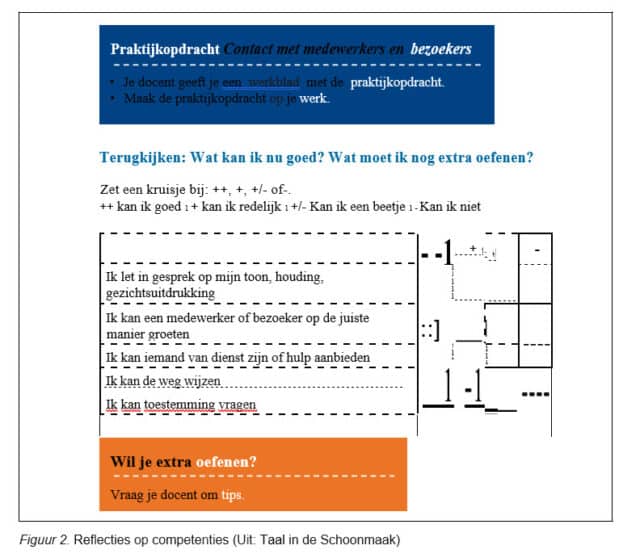
This makes the cleaner visible and part of the office routine. As a result, the employee's conversational skills have become more important. This puts more pressure on the use of the Dutch language. On the other hand, the workbook has become even more concrete. The learning objectives are contained in concrete work competencies in which work-oriented language proficiency is central. Think of things like: 'I can say what the materials and devices are called' and 'I can offer someone help'. Finally, more attention is paid to putting the work competencies into practice and reflecting on them. To this end, competencies are translated into practical assignments that are as concrete as possible. The starting point is that people follow a practice-oriented language trajectory. This enables them to work and communicate competently, so they can function autonomously and maintain better contact with others. These matters are essential for people to remain motivated to learn (Deci & Ryan, 2000).
Transfer of learning
For the design of this renewed workbook, we went back to the core of a learning trajectory, namely transfer. Every learning trajectory—and thus also learning the Dutch language—is only effective if the learned knowledge and skills are applied in the work situation (Bergenhenegouwen & De Mooij, 2011). Three categories play a role in the transfer process:
- personal characteristics, such as intelligence, ability, and motivation;
- design of the learning trajectory, such as the correspondence between the learning and work situation, alignment with the target group, didactic principles, assignments, exercises, and feedback;
- characteristics of the work situation, such as application, support, and guidance at the workplace by supervisors and/or colleagues.
Motivation of participants is of great importance because low-educated individuals become demotivated more often than others while following a course (SER, 2019). Especially people who want to get started quickly, possess few school skills, or have hardly learned to read and write, experience too little success. There are many theories about motivation, but the self-determination theory of Deci & Ryan (2000) is relevant for education and the shop floor. They state that there are three things that ensure an increase in motivation:
- Competence: newcomers feel competent if they understand and can use the Dutch language.
- Autonomy: they will experience autonomy if they see the relationship between the learning trajectory and the work, and if they can perform their tasks independently.
- Relatedness: by performing speaking assignments in the lesson group and at work, contact with colleagues is established.
These factors form the compass for the developer.
To better align the learning trajectory with the work situation, there has been intensive cooperation between employers and language specialists.
They carefully investigated which actions and circumstances a cleaner has to deal with in 2020 and which work-oriented language skills belong to them. The language trajectory for cleaning ultimately contains:
- basic vocabulary for cleaning;
- communicating with colleagues and understanding instructions;
- safe and healthy cleaning;
- 'hospitality'.
During the lessons, vocabulary is first expanded in various ways, for example linked to pictures, different situations, and speech acts (request, explanation, opinion: these are speech acts). In the lessons, dialogues are then listened to, reenacted, and varied in a safe environment. There is little emphasis on grammatical rules. Especially with low-educated newcomers, it is wise to only offer a grammatical structure if it is relevant and typical for a speech act (Bossers, Kuiken & Vermeer, 2015). After the lesson, participants get to work with their new skill in practice.
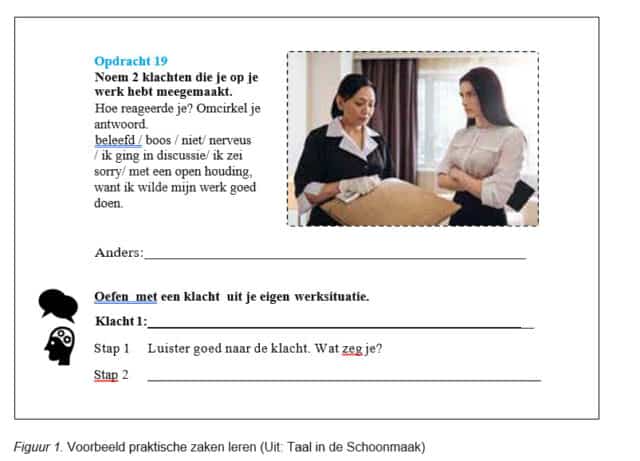
For transfer of learning, direct application in practice is essential. Precisely this transfer is stimulated in the renewed approach: participants experience whether a work competence, translated into a short practical assignment, actually succeeds. Where possible, dialogues with colleagues or office staff are practiced in the field. Participants report on this by making a video or audio recording or by writing messages to colleagues. Participants save these 'proofs' in a digital portfolio, through which they compile a tangible overview of their own development. In the next lesson, recordings of exercises are provided with feedback, personally and sometimes for the whole group. After reflection, the participant and teacher decide together whether more practice is desired or whether sufficient success has been achieved. In this way, the participant explicitly formulates their own progress, which strengthens autonomy.
First results
Evaluation of the first lesson groups that worked with the renewed workbook Language in Cleaning shows that newcomers initially find the practical assignments exciting, but they persevere nonetheless. The first success is therefore that they overcome their fear of speaking. Teachers are enthusiastic. They notice during the lessons and see in the digital portfolios that participants really make an effort to put what they have learned into practice. The result is that lessons are learned much better. Gradually, the participants achieve more and more success. The big win with this method is the direct transfer: the newcomers acquire work-oriented language proficiency. Moreover, they receive appreciation for it: from the teacher, but also from colleagues. In addition, more contact is established with the employer and colleagues. This promotes relatedness. Damen (2013) states that success ensures that participants even want to continue learning more often. This gives the participant opportunities for growth and provides the company with a flexible employee who can more easily learn developments in the field. Employers are also enthusiastic. They have seen for some time that employees work more safely and make fewer mistakes through language lessons (Visscher & Tops, 2015). They also see that newcomers fulfill their role as host/hostess better and function more independently. This approach is also positive for the corporate culture. We notice that colleagues who see a newcomer practicing greatly appreciate this effort. Colleagues are inspired to help. Another advantage is that teams function more closely because more respect and relatedness arise. As a result, people feel better at work and absenteeism also decreases.
Attention from managers and employers
In addition to successes, there are also matters that require extra attention. For example, many colleagues in the cleaning industry do not have a good command of the Dutch language themselves. Furthermore, cleaners often work alone. It remains a challenge to identify enough situations in which short exchanges can be practiced. This requires close cooperation with managers and employers in the search for the most useful and practically feasible possibilities.
In other sectors too, there is more focus on language lessons on the shop floor. Everywhere, a conscious look is taken at situations in which newcomers can actively practice their language knowledge. More and more companies are explicitly encouraging employees to become language buddies, language coaches, or language assistants. In addition to time, this sometimes requires some investment. Together with the employer, we weigh costs and benefits. We see that the role of a language assistant is more than just helping with words. A colleague who helps can be more effective if they receive advice on their role. After advice, they can, for example, better help with pronunciation and sentence structure. They then know that social etiquette is also part of language proficiency. A short instruction for the language assistant can strengthen the learning yield for the newcomer and the company.
1+1=3!
From our experience with language trajectories, we have learned that maximum integration of work with language is effective for the language development of the newcomer. The mentioned workbook is a good example of this. Language training yields more if there is intensive and good cooperation between the language trainers and the company at three moments in the learning process:
- The first step is mapping out the activities and processes on the shop floor for the language training. New developments in the work are also included in this.
- The second step is ensuring a motivating approach to the lessons themselves, by setting practical goals and formulating tailor-made work-oriented language assignments. Here, the knowledge of employees on the shop floor and their cooperation are of great value.
- The third and final step is ensuring success experiences during the lessons and where possible also on the shop floor, so that self-confidence grows. This requires encouragement from the employer and works best with the deployment of collegial language assistants, who are supported by tips and tricks.
Work and language are both important for the newcomer. However, optimal integration of language into work gives the 1+1=3 effect. That is what you want: newcomers learn exactly that language that gives them the chance to find and retain work.
Nina Meilof is a language trainer at TopTaal and specializes in civic integration trajectories for newcomers and Dutch on the shop floor. TopTaal is a service-oriented educational institution for adult Dutch education and develops tailor-made language trajectories for various sectors and at different language and educational levels
Nicole Mol is an educationalist and works as a training advisor and trainer at UL-Team training, specialist in vocational training and courses
for the cleaning industry.
References
- Bergenhenegouwen, G., & Mooijman, E.A.M. (2010). Strategisch opleiden en leren in organisaties (4th edition). Groningen: Noordhoff.
- Bossers, B., Kuiken, F., Vermeer, A. (2015). Handboek Nederlands als tweede taal in het volwassenonderwijs (2nd revised edition, pp 231-243). Bussum: Coutinho.
- Damen, M.A., Sanders, J. & Van Dam, K. (2013). Lifelong learning: The effect of a positive learning experience on the self-efficacy of low-educated individuals. Journal of Labor Issues, 29(4).
- Kalkhoven, (2019, April 17). Factsheet Cleaning 2019. Accessed June 23, 2020, from https://www.uwv.nl/overuwv/kennis-cijfers-en-onderzoek/arbeidsmarktinformatie/factsheet-schoonmaak-2019.aspx
- (2020, March 23). Commencement date of new civic integration system to July 1, 2021. Accessed June 23, 2020 from https://www.rijksoverheid.nl/actueel/nieuws/2020/03/23/ingangsdatum-nieuw-inburgeringsstelsel-naar-1-juli-2021
- Ryan, R.M. & Deci, L. (2000 ). Self-Determination Theory and the Facilitation of Intrinsic Motivation, Social Development, and Well-Being. American Psychologist, 55(1), pp. 68-78.
- (2019, April 12). Working together on language. An advice on low literacy. Downloaded June 23, 2020, from https://www.ser.nl/-/media/ser/downloads/adviezen/2019/samenwerken-aan-taal.pdf
- Serra, (2019). Language in cleaning (version 1.0). Amsterdam: TopTaal and UL-team.
- Reading and Writing Foundation. (2019, June 11. Distribution of low literacy. Downloaded June 23, 2020, from https://www.lezenenschrijven.nl/uploads/editor/2019_Rapport_Spreiding_laaggeletterdheid-webversie_DEF.pdf <
- Visscher, K. and Tops, (2015, April). Investing in language yields a lot: Three business cases for group-oriented language education in the cleaning industry. Accessed June 23, 2020 from https://www.taalakkoord.nl/documenten/publicaties/2015/04/28/rapportage-investeren-in-taal-levert-veel-op